World economy · Public board
The Impact Suite keeps the AI buildout on one board.
Built on Ontology. sundaypyjamas.org is one tenant: a public board the foundation asks in ordinary words.
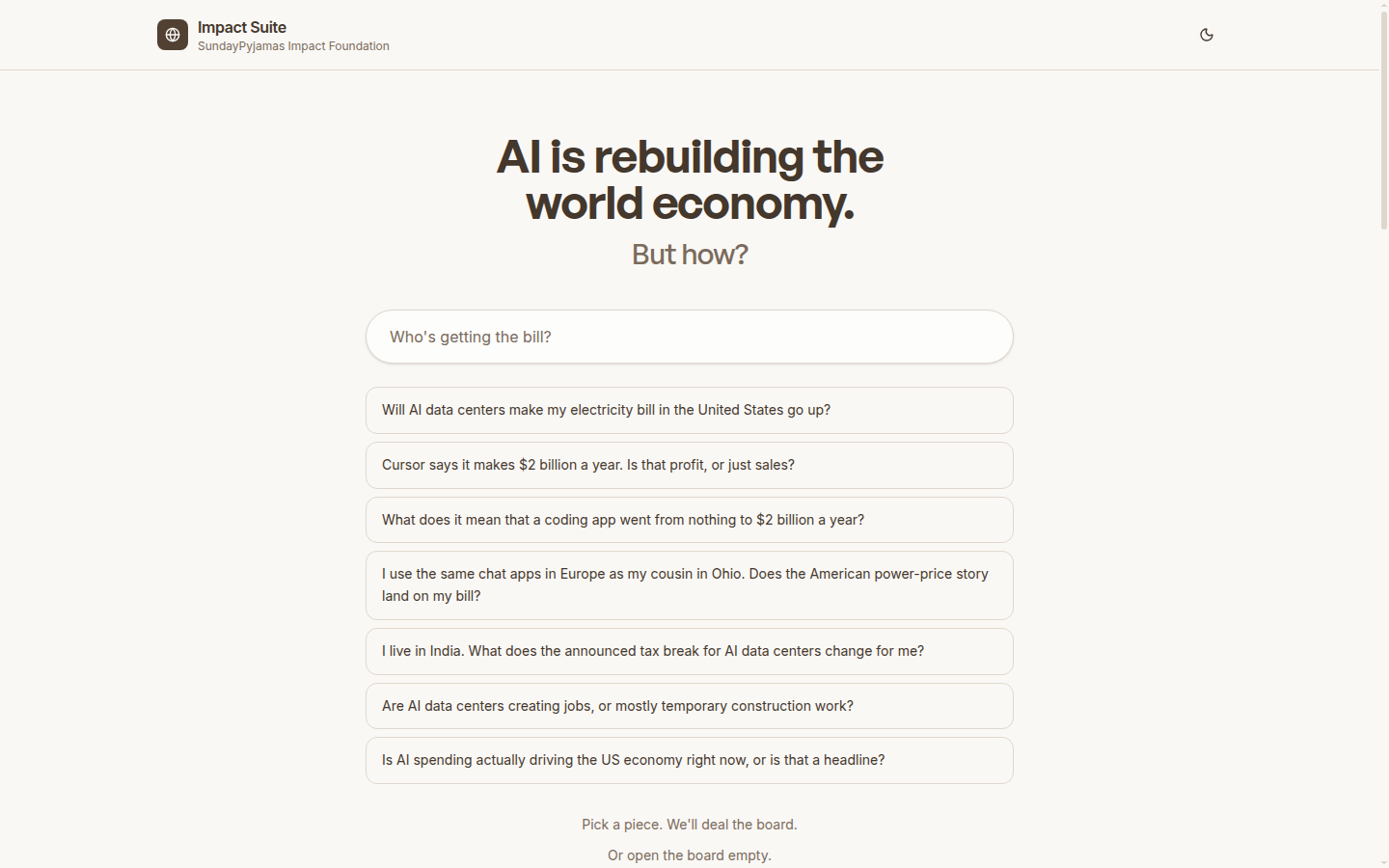
The Impact Suite is built on Ontology. SundayPyjamas Impact Foundation publishes it at sundaypyjamas.org. The product is the workspace graph — a tenant, a registry of types, and the objects and links that registry allows. This deployment uses that engine for the world economy: the public board is the proof, not the definition of Ontology.
The questions cross pieces
The questions on the Impact Suite do not sit inside one article. Will a data-center tax break change a bill in India? Is a coding app’s two billion dollars profit, or sales? Does an American power-price story land on a bill in Europe? Are the jobs mostly temporary construction?
A pile of headlines does not show which claim is about which place, or which source cites it. That is the gap the board is for.
What is public
sundaypyjamas.org is the board. A claim, a place, and a source sit on it. The lines say how those pieces connect. You ask in ordinary words, and the answer sits beside the board.
The same site publishes the method: how a figure is chosen, which sources outrank which, and a changelog of what changed.
On the public board
- A claim, a place, and a source, with a short line between them
- An answer beside the board, in ordinary words
- Narrowing that keeps one question’s neighborhood readable
- A source, a confidence tag, and a vintage on every figure
- Follow the links: sectors, cited claim, jurisdiction, citation chain, observation history
Built on Ontology
A tenant, a versioned registry, and a public board. The Impact Suite is one ontology on AI Suite, not the product itself.
The public changelog records the connection: the AI-economy knowledge graph is defined as a versioned ontology schema, and the Impact Suite is the first case on it. Nothing was automated into the morning briefing yet. The board is the record.
A reader does not meet a schema diagram. They meet a claim, a place, and a source, and a short sentence for the line between them: about, or cited by.
Integration spine
- 01
A claim, a place, and a source sit on the board.
- 02
The line says how those pieces connect.
- 03
You ask in ordinary words.
- 04
The answer sits beside the board.
How the pieces connect
The public board is the case. The line between two pieces is a short sentence. Follow the links walks one policy out to the rest of the record.
Open the Impact SuiteClaim
One cited fact
Statement, source, confidence, vintage
Place
The jurisdiction
What the claim is about
Source
Cited by
The publication the claim points at
Follow the links
Policy outward
Sectors, claim, jurisdiction, citation, history
Record and open web
The record is the part kept on the board. The open web is how the site talks about a place the board has not mapped yet.
A claim, a place, and a source
California’s data-center package is the piece the public site uses to show the board.
The board is a picture of how AI is changing the economy. California’s data-center package is a claim about California. A source cites it. The package reaches environment and urban development.
The piece on the board is the 7-bill data-center package. The place is California. The claim, in the site’s own words: California forces AI data centers to disclose their water and power use.
The answer sits beside the board
Ordinary words in. The record and the open web stay distinct.
You ask in ordinary words. One question the site puts on the page: will AI data centers make my electricity bill in the United States go up? The answer beside the board: your bill is a regional fight, not one national law.
The record is the part kept on the board. The open web is how the site talks about a place the board has not mapped yet. Narrowing keeps the pieces that match and hides the rest, so the neighborhood around one question stays readable.
How it works
- 01
Ask in ordinary words.
- 02
Read the answer beside the pieces it used.
- 03
Narrow the board to the neighborhood of that question.
A figure has to earn its place
A traceable source, a confidence tag, and a vintage. The site says it does not invent numbers.
Every number has to be relevant to the AI buildout as a market, come with a traceable source, and carry a confidence tag and a vintage. When a figure is an estimate, the label says so. Official sources — filings, government data, grid operators — outrank press-reported figures, which outrank proxy estimates.
A projection from a single market-research firm is a scale indicator, not a measurement. When the only evidence is thin, the page says where the data runs out. Figures get revised. The vintage is the as-of date. Updates land as dated changelog entries.
Follow the links from a policy to the sectors it reaches, the cited claim, the jurisdiction, the citation chain, and the observation history.
What the board keeps visible
The public site does not publish a results number for this work. What it does publish is the board itself: you can see the piece, the place, the source, and the line.
You can narrow to one question, follow a policy out to its sectors and its citation history, and read a dated changelog when a figure moves. A quote from the foundation is not on the site.
Open the board
sundaypyjamas.org is the case study. Ontology is the product the board is built on.